If you work on home routers, LTE/5G CPEs or ISP operations, you know the two standards behind remote device management: TR-069 (CWMP), the SOAP-over-HTTP protocol that most CPEs in the field speak, and TR-369 (USP), its successor, which runs over MQTT, WebSocket or STOMP. The server side of TR-069 is called an ACS; the server side of USP is a Controller.
I have just published Dhonomos, an ACS and a USP Controller in one Rust program, under the Apache-2.0 license:
https://github.com/pdh0085/dhonomos
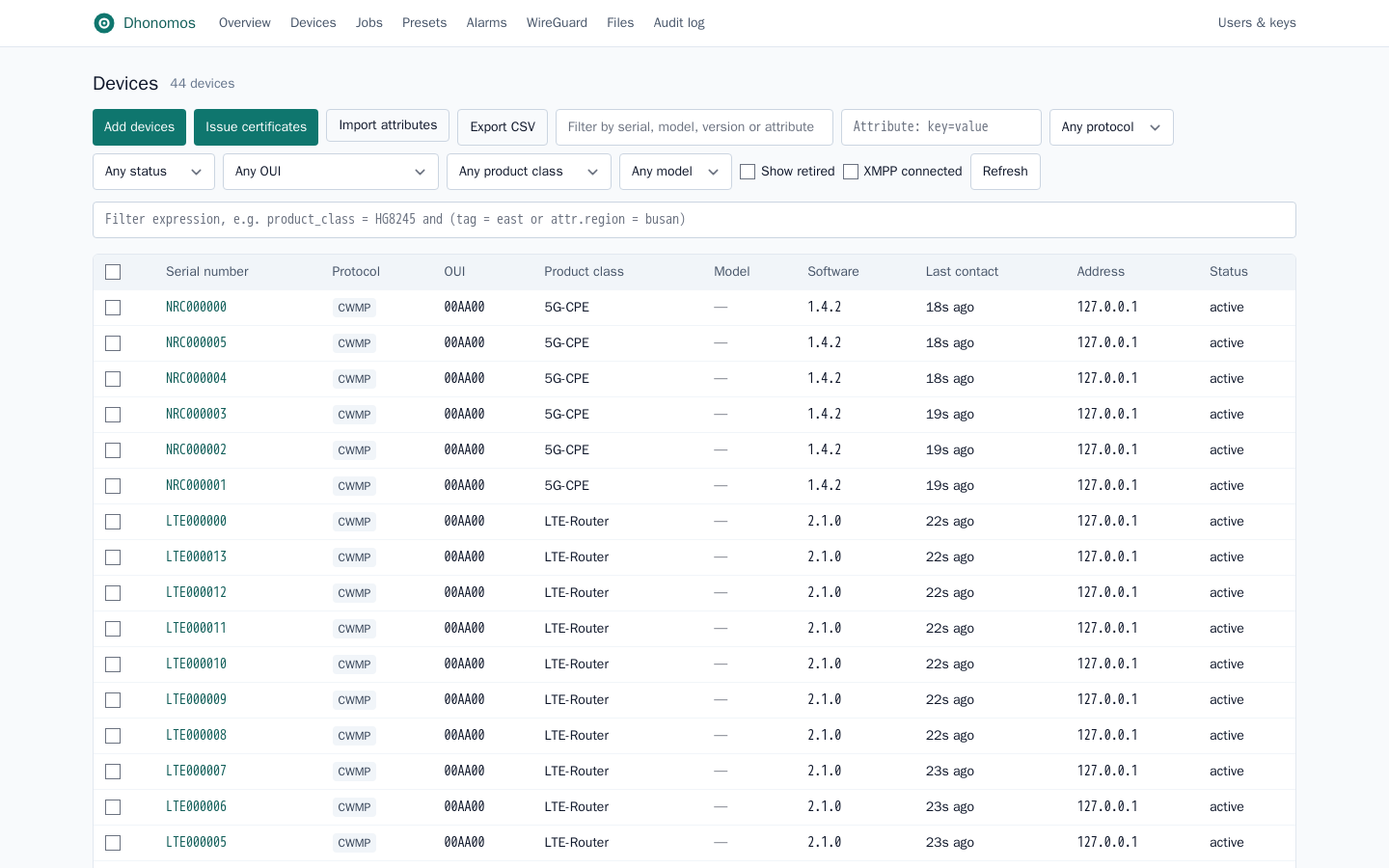
This post explains why it exists, what it does today, and what it does not do yet.
Why Another ACS?
I am a software developer at Lightspeed International, a Taiwanese maker of routers and LTE/5G CPEs. Testing firmware means talking to the devices the way an operator’s server does: reading parameters, changing settings, pushing firmware, and waking devices that sit behind NAT. For that we needed a server we could run in the lab, read the code of, and change when a device did something unusual.
The open-source choices were few. Commercial ACS products are expensive and closed. The best-known open-source ACS is licensed under the AGPL, which many companies will not run or modify. And open-source USP Controllers that a small team can actually deploy are rare, even though USP Agents (such as the open-source obuspa) are already in products.
So Dhonomos started as a test helper in our lab and grew into a full server. The company agreed to release it as open source.
What It Does
CWMP ACS
- TR-069 Amendment 6 sessions (CWMP 1.0-1.4) over TLS, with Digest or Basic auth.
- Per-device credentials bound to their device, optionally issued on first contact. After that, the shared credential no longer works for that device.
- Zero-touch onboarding: a new device is read in full on its first Inform, under a policy (accept all, quarantine, pre-registered only, OUI allow-list).
- Connection Requests over HTTP, over UDP with a built-in STUN server, and over XMPP with a built-in XMPP server. XMPP matters for CPEs behind carrier-grade NAT: the device keeps a TCP connection open to the server, and the wake-up goes down that connection with a delivery confirmation.
- A built-in file server for firmware and configuration files, with signed links and bandwidth limits.
USP Controller
- MTPs: MQTT 5 (through an external broker such as Mosquitto, or a broker built into Dhonomos), WebSocket in both directions, and STOMP 1.2 with a built-in broker.
- Its own CA for Agent certificates, with issuing, an expiry list and revocation. An EndpointID that has a certificate cannot be claimed over a weaker MTP.
Operations
- A task queue with retries, presets (YAML or web UI) and sandboxed provisioning scripts in Rune, a small embeddable language for Rust.
- Bulk jobs and firmware campaigns with canary stages and an automatic pause when too many devices fail.
- Diagnostics with one result format for CWMP and USP: ping, traceroute, DNS, TR-143 speed tests, Wi-Fi neighbours.
- Configuration backup, drift detection, restore and device replacement.
- WireGuard tunnels to devices, managed from the server, with an optional hub program.
- A REST API with an OpenAPI 3.1 document, a web UI (SvelteKit) built into the binary, roles, device scopes per team, OpenID Connect single sign-on, TOTP two-factor authentication and an audit log.
The whole server is one executable plus PostgreSQL. The container image is a static musl binary on an empty base image, about 22 MB.
How It Performs
On a 12-core Xeon E5-2630 (2.3 GHz) with PostgreSQL on the same host, a simulator drove
50,000 virtual CPEs at about 2,000 periodic Informs per second for 60 seconds: no errors,
Inform p50 9.9 ms and p99 441 ms, and 113 MB of memory for the server. That run used a
larger database pool and session limit than the defaults (96 connections, 4,096 concurrent
sessions); with the defaults the same load gets 5.7% of sessions turned away with 503. The
simulator and the benchmark harness are in the repository (crates/simulator,
cargo xtask bench), so you can repeat the measurement.
Why Rust
A management server sits on the internet edge of an ISP and parses input from tens of
thousands of devices it does not control. Memory safety matters there, and so does a small,
predictable footprint. Rust gave us both, plus a strong ecosystem for the parts we needed:
tokio and axum for the network side, sqlx with compile-time checked queries for PostgreSQL,
prost for USP protobuf, rustls for TLS. unsafe is forbidden in every crate but one,
which has a single, documented getsockopt call, and the protocol parsers have fuzz targets.
What It Does Not Do Yet
Honesty first:
- It is pre-1.0. There are no releases yet; you build it from source. Flags, the API and the database schema can still change.
- There has been no external security review yet, only internal ones.
- The operations guides are in Korean; the README and the installation guide are in English.
- Full multi-tenancy is not there yet.
- It has been tested with OpenWrt-based CPEs and with simulators. Devices from other vendors may show behaviour we have not met yet. Reports are very welcome.
Try It
git clone https://github.com/pdh0085/dhonomos.git && cd dhonomos
docker build -t dhonomos:dev .
cp deploy/dhonomos.env.example deploy/dhonomos.env   # fill in the secrets, CPE credentials, ACS cert
docker compose -f deploy/docker-compose.yml up -d
Then point a CPE’s ACS URL at the server. The installation guide walks through TLS, the first CPE and the first USP Agent.
The Name
Dhonomos is “DH” (my initials) plus oikonomos, the Greek word for the steward of a household, and the root of the word economy. A server that looks after the devices in subscribers’ homes seemed a fitting job for a steward.
If you run an ACS today, build CPEs, or are looking for a USP Controller, I would like to hear what you need. Issues are open on GitHub.